Lisinopril
- Class: ACE inhibitor
- Used for: high blood pressure
- Say it: lye-SIN-oh-pril
- Forms: tablet, oral liquid
LISINOPRIL = LOOSEN-a-pril. It loosens the squeezed blood vessels until the pressure drops.
Blocking ACE means less angiotensin II, the hormone that tightens vessels — so they genuinely do loosen.
Every ACE inhibitor ends in -pril. Blocking ACE also lets bradykinin build up, which is why a dry tickly cough is the classic side effect.
The mechanism comic
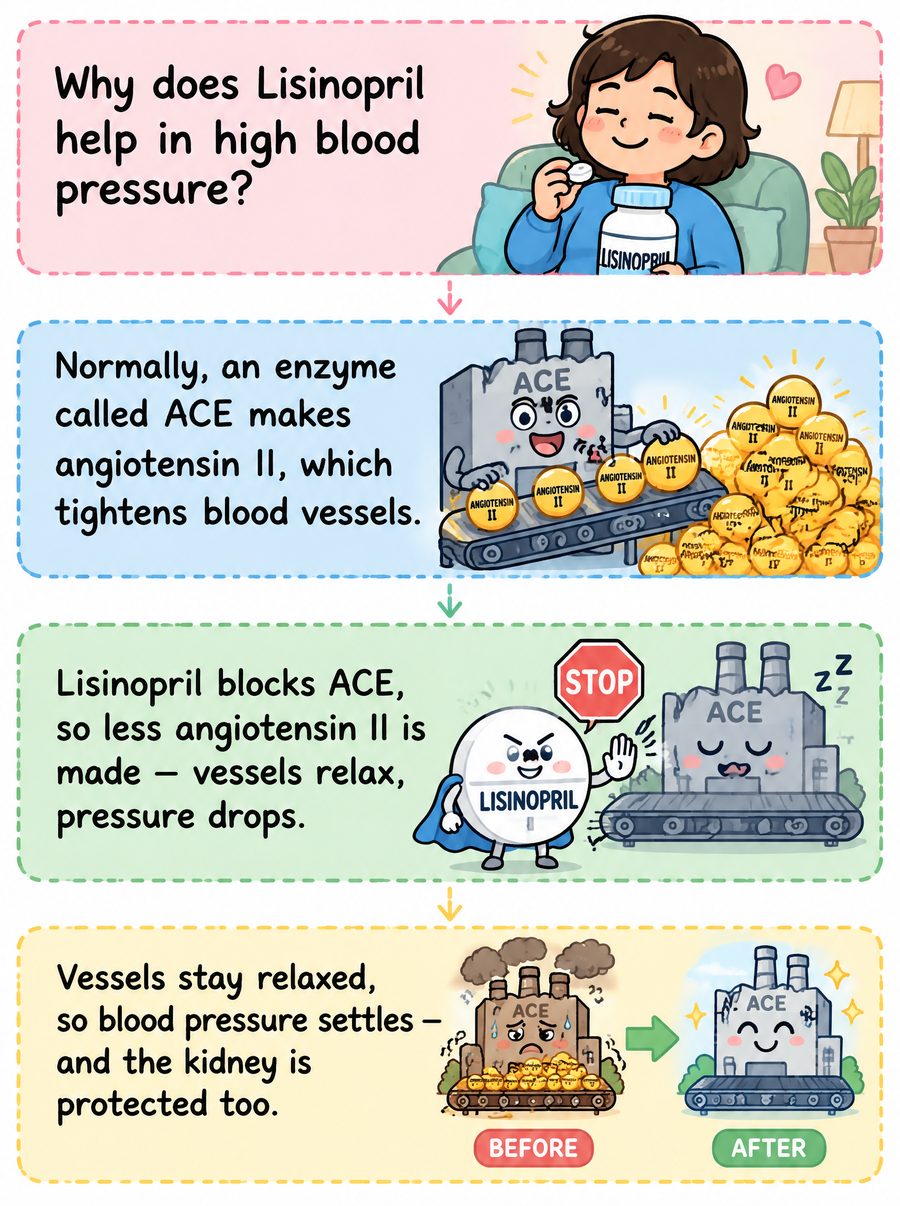
One of five sample comics. The app has one for each of the 100 drugs.
Side effects
Common: dry cough, dizziness, high potassium
Serious: angioedema, kidney injury
Typical dose
10–40 mg once daily
Start at 2.5–5 mg, and halve that if the patient is already on a diuretic. Increase no faster than every two weeks.
Check yourself
How does Lisinopril lower blood pressure?
- It blocks the AT1 receptor so angiotensin II cannot dock
- It blocks ACE, so less angiotensin II is made at all
- It blocks calcium entry into vessel-wall muscle
- It blocks beta-1 receptors on the heart
Show answer
B. It blocks ACE, so less angiotensin II is made at all
Lisinopril blocks the enzyme, so angiotensin II is never made. Losartan — option one — leaves angiotensin II intact and blocks its docking site instead. Same end result, but only the ACE inhibitor causes the bradykinin cough.
See it, don't memorize it
The app has the mechanism comic and a patient case for Lisinopril – plus the name link, the class mnemonic, pronunciation you can hear, and a self-check, for the top 100 drugs. One purchase, no subscription, no account.